
.jpg)
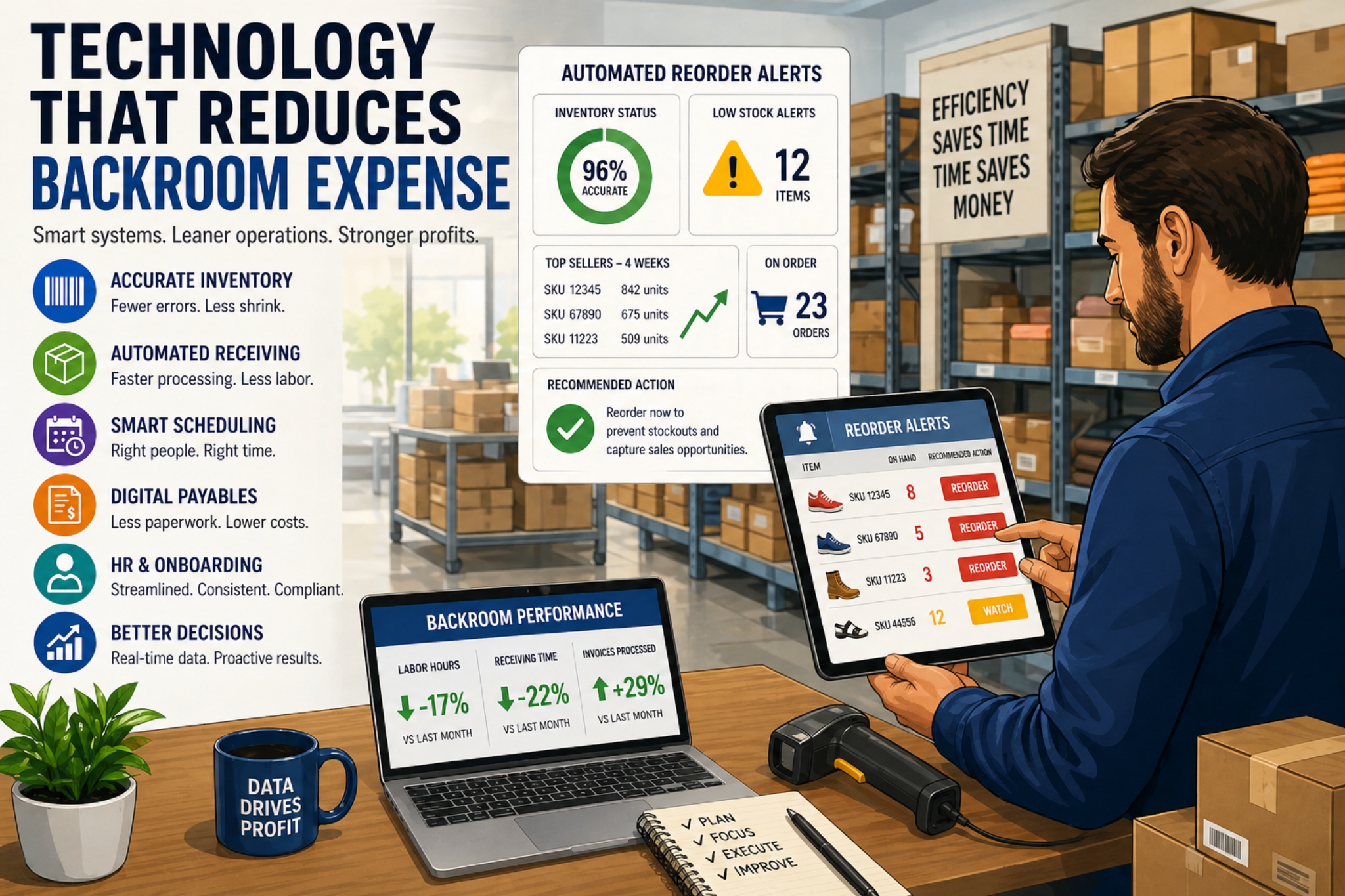
For many retailers, the selling floor gets the spotlight while the backroom quietly drains profit. Customers see displays, service, and merchandise. Owners see payroll, shrink, delayed receiving, inventory errors, paperwork, and overtime. The backroom may be out of sight, but it should never be out of mind.
As operating costs continue to rise, especially wages, benefits, occupancy, and insurance, retailers can no longer afford outdated backroom habits built for another era. Tasks once handled manually because labor was inexpensive now deserve a second look. Technology is no longer optional overhead. It is an expense-control tool.
The retailers who adapt will run leaner, faster, and more accurately. Those who delay may find themselves carrying a growing hidden tax in unnecessary labor and inefficiency.
Why the Backroom Matters More Than Ever
Many businesses focus heavily on driving sales while underestimating how much profit is won or lost behind the curtain. A store can generate respectable revenue and still underperform because support functions are bloated.
Common backroom expense leaks include:
• Duplicate data entry
• Manual invoice processing
• Inefficient receiving procedures
• Excessive time spent searching for inventory
• Poor transfer tracking between locations
• Overstock caused by weak replenishment systems
• Excess labor scheduling without productivity standards
• Paper-heavy HR and onboarding processes
• Uncoordinated markdown execution
• Preventable errors requiring rework
Each leak may seem small on its own. Together, they can become a monthly avalanche.
Technology Has Changed the Cost Equation
In years past, some retailers tolerated inefficiency because labor costs were lower and systems were expensive or difficult to implement. That equation has changed.
Today, many tools are cloud-based, subscription-priced, scalable, and more user-friendly. At the same time, labor is costlier and harder to find. This flips the math.
If a store saves 25 payroll hours per week through better systems, that is not merely convenience. It is a structural financial improvement.
Retailers should view technology through this lens:
What recurring labor cost can this tool eliminate, reduce, or redeploy?
That is the real scoreboard.
Areas Where Technology Can Reduce Backroom Expense
1. Inventory Accuracy and Speed
Inventory mistakes create expensive chain reactions: stockouts, missed sales, duplicate orders, markdown buildup, and staff time spent hunting for product.
Modern tools can help through:
• Barcode scanning for receiving and transfers
• Mobile inventory counts
• Automated reorder alerts
• Real-time stock visibility across locations
• Exception reporting for negative on-hand or stale inventory
When inventory becomes cleaner, labor becomes more productive. Staff members stop playing detective and start executing.
2. Smarter Receiving Operations
Receiving merchandise manually with clipboards and handwritten notes belongs in the museum wing of retail history.
Digitized receiving can:
• Reduce check-in time
• Identify shortages immediately
• Capture discrepancies for vendor follow-up
• Update inventory faster
• Improve speed to floor
The faster merchandise reaches the sales floor, the sooner it can earn rent.
3. Payroll and Scheduling Controls
Scheduling by instinct often leads to overstaffing slow periods and understaffing peak times.
Modern scheduling systems can align staffing with:
• Historical traffic patterns
• Sales volume by hour
• Seasonal demand
• Employee availability
• Labor budget targets
This does not remove management judgment. It improves it.
4. Accounts Payable Efficiency
Many retailers still process invoices manually, approving paper stacks like a 1994 office drama.
Digital AP systems can:
• Match invoices to purchase orders
• Route approvals electronically
• Reduce late fees
• Improve cash planning
• Cut clerical handling time
Clean payables systems also strengthen vendor relationships through more reliable payment timing.
5. HR and Onboarding Automation
Hiring one employee manually is manageable. Hiring dozens over time becomes a paper swamp.
Technology can streamline:
• Job postings
• Applicant screening
• Digital forms
• Training modules
• Policy acknowledgments
• Time-clock integration
That saves administrative time while improving consistency and compliance.
The Hidden Win: Better Decision-Making
Technology is not only about doing tasks faster. It is about making better decisions sooner.
Consider a retailer reviewing these reports weekly:
• Slow-moving inventory by category
• Fill-in opportunities on top sellers
• Gross margin by vendor
• Labor cost as a percent of sales
• Receiving delays by supplier
• Markdown trends by department
That owner can act early rather than explain poor results later.
Good reporting turns management from reactive firefighting into proactive steering.
Common Mistakes to Avoid
Buying Technology Without Process Discipline
Software cannot fix chaos by magic wand. If procedures are weak, new systems may simply digitize disorder.
First define:
• Who owns each task
• What the workflow should be
• Which metrics matter
• How accountability will be tracked
Then layer technology onto a sound process.
Overbuying Complexity
Some retailers purchase enterprise-level systems when a simpler solution would deliver 80 percent of the benefit.
Choose tools appropriate for:
• Store count
• Transaction volume
• Staff skill level
• Budget
• Growth plans
Fancy dashboards nobody uses are expensive wallpaper.
Failing to Train Staff
Even excellent systems fail when training is treated as an afterthought.
Training should include:
• Why the tool matters
• How success will be measured
• Clear operating standards
• Follow-up coaching
Otherwise, systems become digital furniture.
A Practical Starting Plan
Retailers do not need to modernize everything at once. Start where labor waste is largest.
Step 1: Audit Backroom Hours
Track where support payroll hours go for 30 days.
Step 2: Identify Repetitive Tasks
Repetition is fertile soil for automation.
Step 3: Measure Error Costs
Returns, credits, recounts, missed transfers, and late fees all have labor attached.
Step 4: Prioritize Quick Wins
Begin with tools likely to pay back within 6 to 12 months.
Step 5: Build a Continuous Improvement Mindset
Technology adoption is not a one-time event. It is an operating philosophy.
Retail Reality: Expense Control Is the New Growth Engine
Many markets are mature. Traffic can fluctuate. Consumer behavior shifts quickly. Growing sales is still important, but protecting profit through expense discipline has become equally vital.
A retailer who trims unnecessary backroom cost by $75,000 annually may improve bottom-line performance more reliably than chasing an uncertain $300,000 in incremental sales.
That is not glamorous. It is smart.
Conclusion
The backroom is where silent profit leaks hide. Rising costs mean retailers must use technology more aggressively to simplify workflows, reduce manual labor, improve accuracy, and sharpen decision-making.
The goal is not replacing people. It is allowing people to spend less time on low-value tasks and more time where humans matter most: selling, serving, solving problems, and building customer loyalty.
Retail history is filled with stores that loved tradition more than progress. The future usually sends flowers to someone else. n
Alan Miklofsky is a semi-retired, self-described “Professional Shoe Dog” with a distinguished career. Over the decades,
he successfully ran an award-winning shoe business while dedicating his time to the National Shoe Retailers Association (NSRA) Board of Directors, including serving as Chairperson from 2009 to 2011. Today, Alan channels his expertise into creating content for business owners and consumers, and offering consulting services focused on financial oversight. Learn more at www.AlanMiklofsky.com or connect with him on LinkedIn.


.svg)