

Making the economics of independent footwear retail work is no easy task. Climbing costs, multichannel competition, battling for margins, the list of challenges goes on. But on the retail floor, the formula for success remains unchanged: offering unique, compelling, and profitable products to customers.
To find that sweet spot, a new kind of collaborative partnership is developing. Some forward-thinking retailers are no longer just buying brands—they are selling them to other retailers, and in some case creating the brands themselves. Sitting on both sides of the desk as retailers and wholesalers has given these independents a new take on brand and retail partnership.
Tradehome Shoes
RIVAL
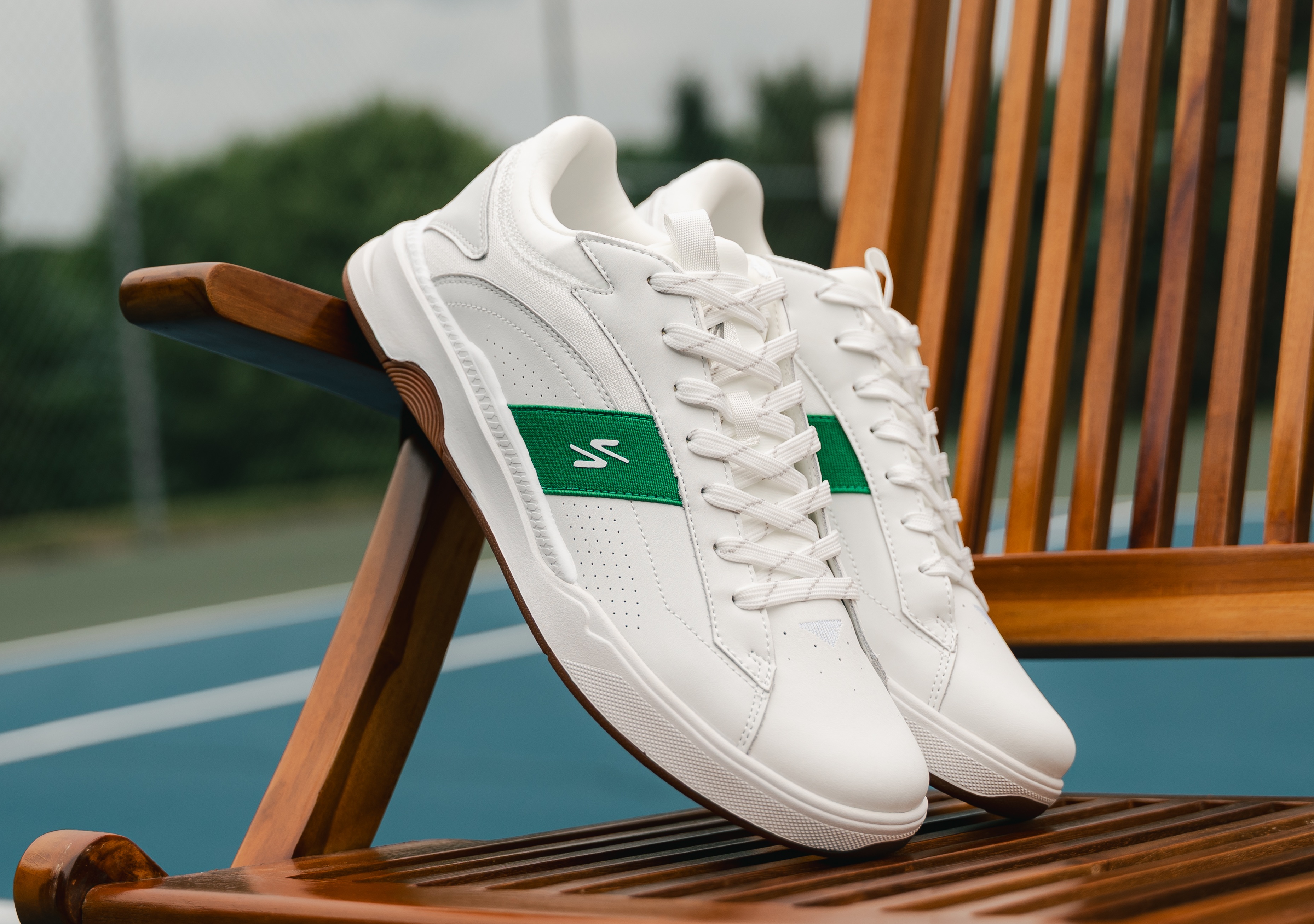
The footwear brand RIVAL was initially launched by the Tradehome Shoes team in 2022 to focus on creating unique products in categories where the retailer had identified voids. Taking the next step to make the brand available via wholesale made sense, Tradehome Shoes president and CEO Justin Kehrwald tells us: “We felt it was logical that if Tradehome had voids, other retailers did too.”
The goal with RIVAL is to design modern footwear for everyday wear. “As other brands aspire to make more and more technically advanced products at a higher and higher price, our goal is to make approachable footwear at an approachable retail price.”
From its wholesale partners, Kehrwald says the feedback he has gotten is that RIVAL offers “a legitimate value for the consumer, and our wholesale pricing/margin structure is extremely appealing to retailers.”
Because RIVAL’s founders come from sales floor and retail buying backgrounds, the understanding that collaboration and communication are keys to success are evident. RIVAL does not have minimums for its wholesale business. While the brand does have a DTC presence, the focus is on developing brand awareness at retail, Kehrwald notes.
Tradehome’s retail footprint serves as a testing lab. “We want to present proven winners to our wholesale accounts,” Kehrwald says. “With Tradehome having locations in over 30 states, we’ve found providing regional data tremendously meaningful.”
On the ground, brand trust is built from the bottom up. Tradehome’s store personnel act as primary brand ambassadors, driving consumer awareness and sending feedback straight back to the design team.
As a retailer in the wholesale game, navigating perceived competition with some of its partners is also something that comes with the territory.
“We recognize that in some cases Tradehome’s growth and success could be looked at as a deterrent for potential RIVAL retailers,” explains Kehrwald. “We are focused on presenting a strong value proposition to prospective accounts. RIVAL’s goal is to create its own space in the market. The brands Tradehome works with have seen that RIVAL is not interested in making versions of their products. Communication is key.”
The approach is working. Following a successful 2026, RIVAL’s new silhouettes and colorways for early 2027 have been well received. “We’ve added some key people focused on wholesale development and have secured a couple of exciting brand partners,” says Kehrwald. “We are very optimistic about next year.”
ERHCo INC.
Ziera & Django & Juliette

Oregon-based ERHCo—the family-owned operator of regional retail staples Shoe Mill, Burch’s, and Footwise—entered the wholesale arena completely by chance.
“It was accidental,” recalls Josh Habre, president and CEO, ERHCo Inc. “We wanted to help Ziera solve their biggest challenge in the U.S. which was slow replenishment. Everything from initial orders to single pair fill-ins was shipped from the southern hemisphere, so to shorten that time down we offered to be their third party in the US. They approached us six months later about being the full U.S. distributors and the rest is, as Bob Ross would say, a ‘Happy Accident.’”
Today, ERHCo acts as the exclusive U.S. distributor and wholesaler for two distinct brands: Ziera and Django & Juliette. The venture has taught Habre a key lesson: “Both vendors and retailers are mixing art and science to accomplish the impossible task of having the right amount of the right shoes at the right time in order to sell as much as possible for the highest price possible while having as little excess as possible. And there is no such thing as easy money on either side.”
Ziera shoes are built on lasts that hug the heel and give the toes plenty of room to move. Django & Juliette styles feature unique styling and soft leathers. And the margins for both brands are “very healthy,” says Habre. “The gross margin dollars on inventory that can turn quickly is compelling,” he says.
Sitting on “both sides of the desk” has given Habre a different perspective when selling to other shoe retailers. “As a vendor, I cut the fluff out of line presentations,” he says. “The shoes are the star of the show so get to the shoes. Strategically, the marketing supports the great shoes, the shoes are not props in marketing materials.”
Conversely, the wholesale experience has also taught him lessons as a merchant: “As a retailer, we are far more empathetic with issues brands face that can impact us. I am thankful for what the brands do to help the retailer.”
Knowing that many independents feel squeezed by massive minimums and DTC has also helped guide ERHCo’s wholesale business partnerships.
“With both brands, we allow and encourage the retailer to test with whatever sizes and quantities they are comfortable with,” Habre says. “I believe it is better for a retailer to feel they could have sold more rather than having excess inventory. This decision we made early on and we knew it would mean slow growth the first few years. However, combined with a careful DTC strategy, the goal is to build brands with long-term staying power, not going for the quick cash grab.”
And ERHCo’s own retail floors are “absolutely” used as a “testing lab” for new silhouettes and designs. “We view Ziera and Django & Juliette as complimentary to the brands we carry and not replacements. So, filling the space that exists between the brands proves their viability in the marketplace in general,” says Habre.
Still, as a retailer and a wholesaler, Habre is aware that some retailers view him as a competitor and will shy away from carrying the brands.
“Yes, retailers have told me they wouldn’t buy because we are also retailers,” he says. “I was bothered by that at first, but I got over it. I remembered selling on the floor, customers making decisions that I couldn’t understand, and I had to move on. So…the same thing applies here. With brands it hasn’t been an issue at all.”
As for the future, Habre is excited for the year ahead: “We have an awesome collaboration in the works with another family business set to launch this fall. My brothers and I have begun working alongside other family businesses, sharing our experiences and helping as they work through challenges or look to capitalize on opportunities. We have capacity for another retail acquisition in 2027 and are actively working to that end. And who knows, maybe we will be working to bring some other brands to the market…”
Hawley Lane Shoes
asgi
.jpg)
For David Levy and Joe Gardia, owners of Hawley Lane Shoes—a five-store independent retailer in Connecticut—the motivation to build their own brand was clear.
“We originally developed the asgi brand to solve problems we were experiencing firsthand at Hawley Lane Shoes,” says Levy, who launched asgi earlier this year with Gardia and factory owner Paul Lim. “Once we saw the model working in our own stores, we realized those same challenges were being faced by independent footwear retailers everywhere.”
The main issue Hawley Lane Shoes was having? Financial survival. “We needed to make more money at Hawley Lane Shoes, but we absolutely refused to do it by sacrificing the quality, comfort, fit or service we provide our customers,” Levy notes. With operating overhead spiking across the board, Levy and Gardia needed a way to increase the profitability of what they were selling.
With their decades of footwear industry experience, the asgi founders developed their new brand with this question in mind: What does the consumer need from the product, and what does the retailer need economically?
Levy says, “We didn’t want to make more money by giving our customers less.. We wanted to make more money while giving them more. That became the foundation of asgi.”
They engineered a product balancing aesthetics with whole European sizing, multiple widths, premium leather linings, and a specialized biomechanical orthotic footbed that delivers what Levy calls “addictive comfort.” But the true innovation was designing the economics of the brand from the retailer backwards.
The pricing model for asgi leaves room for a permanent $10-per-pair sales associate spiff while still preserving an exceptional margin for the store owner. “It has worked incredibly well,” says Levy. “Our associates make more money, it has been terrific for morale, and our salespeople become asgi brand builders while the store still retains an exceptional margin.”
As seasoned retailers, the asgi team knows that initial margin is great, but it “doesn’t mean much if you eventually give it back through markdowns,” notes Levy. “That’s why our real financial objective isn’t simply margin. It’s GMROI—generating more gross-margin dollars from every inventory dollar the retailer invests.”
The philosophy is simple, says Levy: “Buy less. Buy better. Turn it faster. Maintain the margin. Reorder the winners.”
Being a true partner to other retailers is important for Levy. “I’m not thinking, ‘How much product can I sell this account?, I’m thinking: ‘If this were Hawley Lane Shoes, would I buy this? How many would I buy? Which colors and widths? And how quickly could I turn my investment?’”
The asgi team doesn’t believe an independent retailer should have to make a huge financial bet on a brand they haven’t carried before. “Our message is simple: Start small. Let the product earn the business. Then reorder and grow based on actual results,” Levy highlights.
Hawley Lane Shoes is also a key part of the entire asgi formula, testing the shoes out in real time on the sales floor. The asgi design team develops several styles that it filters through before presenting to wholesale partners, narrowing down the assortment of “winners” in its own retail stores first.
“We are ONLY looking for winners,” says Levy. “We’re looking for the shoes that sell out. Then, and only then, do we offer those styles to our wholesale partners. Our retail friends shouldn’t have to spend their money figuring out which of our shoes sell and which don’t. We take that risk first at Hawley Lane Shoes. If we can give our retail partners a much narrower assortment made up of proven winners, they can turn their inventory faster and, most importantly, eliminate most of the markdowns that destroy profitability.”
Over the next few years, Levy says he wants asgi to become known for two things. “For consumers, I want it known for exceptionally comfortable, supportive, great-fitting footwear. For retailers, I want asgi known as being the most profitable economic model for independent footwear retail.”
He says, “I don’t believe the answer for independents is necessarily carrying more and more product. I think the opportunity is to become much smarter about which product we carry. Ultimately, we want a model where the consumer gets a great product, the associate makes more money, the retailer makes more money, our factory succeeds and asgi succeeds. To me, that’s what a true partnership looks like.”
HOSS BOOT CO & Private Label Partnership
Bringing yet another unique aspect to the brand and retail partnership spectrum is Hoss Boot Company, which sells its own line of boot brands wholesale and also has a private label business making boots for a select number of retailers across the U.S.
How does that partnership work? Since 2019, Hoss Boot Co. has been making private label safety, work, and western footwear for independent dealers ranging from family-owned stores (such as Beck’s Shoes) to regional discount chains. In an era where overseas factories frequently solicit American retailers directly via email, Hoss has carved out a vital niche based on absolute accountability.
“The retailer does not have a relationship with the factory; the factory does not understand their business,” says Don Colbert, president, Hoss Boot Company. “We have relationships with both and guarantee what we sample is what they get. We stand behind the process.”
The process is collaborative: retailers identify a specific target category, and Hoss provides tailored options for outsoles, insoles, and premium leathers (sourcing U.S. leather when possible). Hoss can handle everything from CAD drawings to custom logo and packaging design, matching the program to realistic minimum order quantities (MOQs) and flexible terms.
Importantly, Hoss builds distinct styles for its private label partners to avoid shelf conflict with its own branded line. “We don’t make the same styles as a Hoss boot. So really, we are not competing,” Colbert notes. “Often in the safety world, retailers do it to meet a low subsidy or to improve their margin or both.”
For retailers, offering a private label footwear line can act as an equalizer of sorts against big-box chains. “If retailers have good salespeople on the floor, they can sell their own brand on features and benefits over a brand name,” Colbert explains. “Make more money for the store and ensure a great customer experience. Sprinkle it in with their other brands. The whole idea really is to make more margins.”


.svg)