

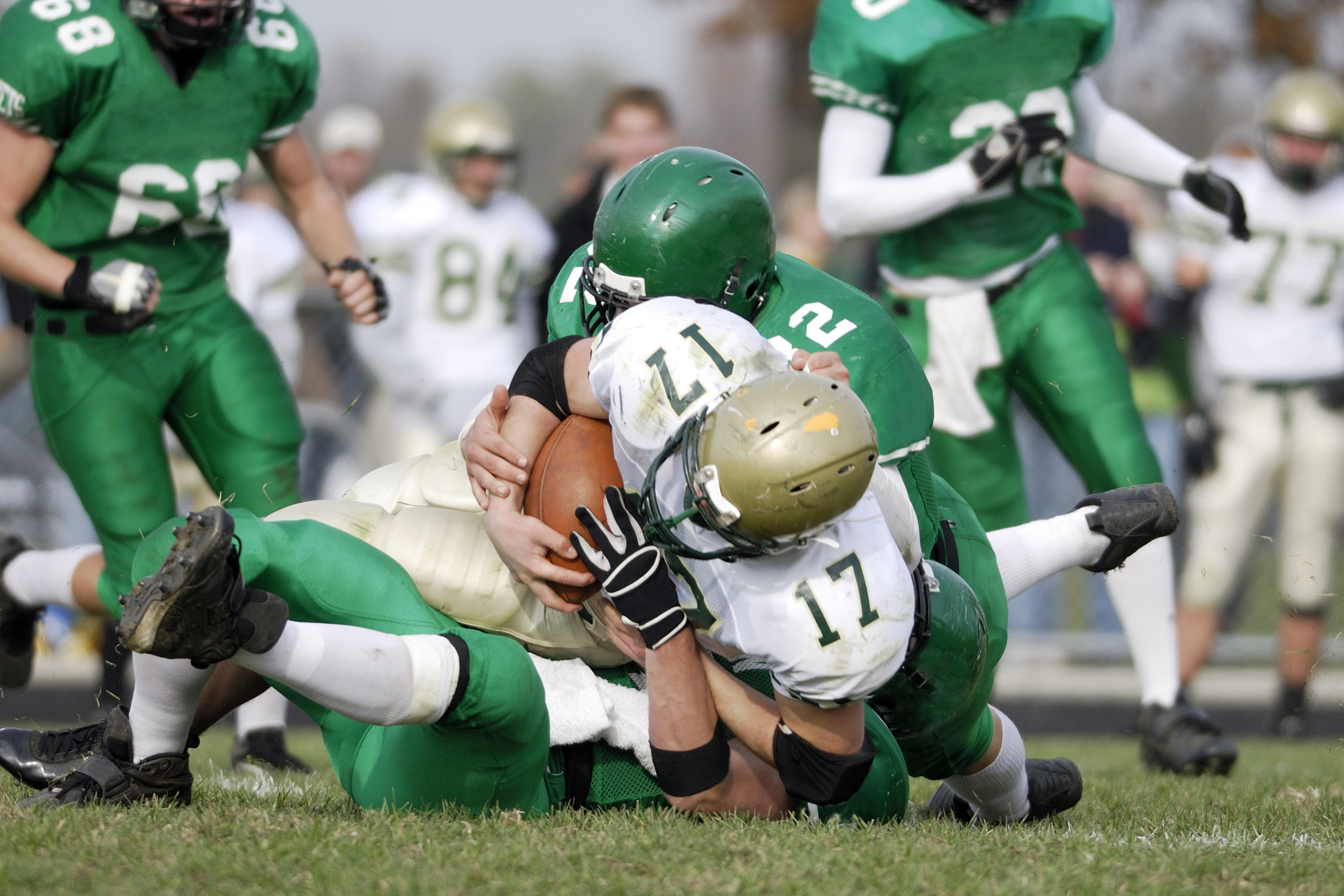
Football, at its core, is a somewhat curious sport. It is by far the most popular team sport from the perspective of attendance, TV viewership and fandom, even though the number of actual participants in tackle football is less than it is for other major team sports such as basketball, baseball, soccer and court volleyball — not to mention its non-contact “cousin,” flag football.
Maybe a quick break for a history lesson will help explain it: The most pivotal moment in the game of tackle football took place late 1905, when a rather upset U.S. President Theodore Roosevelt threatened to abolish the game, played predominantly at eastern colleges and universities, if something wasn’t done quickly to make the game safer. After all, in the fall of 1905 there were 18 deaths and 159 major, catastrophic injuries. Roosevelt demanded immediate action and he got it.
As a result of pressure from the White House, two organizations were founded to quickly address the concerns of President Roosevelt. In the spring of 1906, the National Collegiate Athletic Association (NCAA) and the Sporting Goods Manufacturers Association (SGMA), now known as the Sports & Fitness Industry Association (SFIA), were formed. These two organizations made immediate and drastic changes to the rules of the game, the equipment used in the sport and the uniforms worn by the athletes. The sport of tackle football was saved.
Many years later, in 1931, then Notre Dame head football coach Knute Rockne issued strong words of praise for the U.S. manufacturers of football products.
“I want to compliment the sporting goods manufacturers on the fine protective measures they have given football,” Rockne, firmly established as one of the leading figures in collegiate football, said at the time. “Despite the much larger number of football players, there are fewer injuries now than in past years. The biggest factor in reducing the number of injuries has been the added protection which has been built into football equipment. Your industry is a fine asset to college athletics. You are making equipment right and selling it right.”
Sadly, a few months later, Rockne was killed in an airplane crash.
Football Here and Now
Fast forward a few decades and the sport is still struggling with those same safety issues, even as the equipment has progressed further than Teddy Roosevelt or Knute Rockne could have ever imagined. That means that, depending on your perspective, the sport is either thriving, suffering or dealing with the ebbs and flows that can impact any sport over time.
On a positive note, according to the National Federation of State High School Associations (NFHS), participation in 11-player tackle football is strong. The most recent figures – from the 2024-25 school year – indicate there were just over one million high school football players — of which 4,837 were female. The top-five most popular states for 11-player high school football are Texas, California, Ohio, Florida and Illinois.
Another positive has been the willingness of the game’s administrators to be flexible with the game’s rather strict rules, policies and procedures. Case in point: At the high school level there are now thousands of athletes playing an amended version of the 11-man game — 6803 playing six-player football, 22,000 playing eight-player, and 6833 playing nine-player football. Some high schools simply don’t have enough athletes to form a roster big enough for the traditional 11-player game so adjustments have been made.
For perspective, the only other high school sport with more than one million participants is track and field. The two next most popular sports are basketball and soccer.
However, the negative aspects of football can be harsh — and these are eventually felt by team dealers in their cash registers. The concussion and injury issues remain front and center, despite the improvements in protective gear and rules changes designed to make the sport safer. Continued reports of former football players being diagnosed with CTE leaves many athletes and their parents questioning whether they should play the sport at all.
As a result, not all football programs thrive and remain alive. One specific example is at Berean Christian School in West Palm Beach, FL, which decided to “hit the pause button” last summer and suspend its football program due to a lack of interest. That suspension remains in place for the 2026 fall season.
That and other similar “pauses” are hopefully not a harbinger of things to come.
Team Dealers Talk Football
Team dealers across America certainly hope that is not the case, preferring to look on the bright side of what is arguably their most important sport.
For example, even in a state such as Indiana where basketball is a statewide passion for the Hoosier population, football is the top-generating category for Kratz Sporting Goods, Clarksville, and Coaches Corner in Terre Haute. The same can be said for Iowa Sports Supply Company in Cedar Falls, where wrestling may be Iowa’s signature sport, but football still generates more revenue.
And in Wilmington, DE, Al’s Sporting Goods has a unique commercial setting with a thriving retail store and a team division where large uniform and equipment orders are placed.
According to owner Bob Hart, his firm has a strong business in both outlets. “In our retail store, we sell football cleats, pants, shoulder pads, helmets and, of course, footballs,” he tells Team Insight. “On the team side, we sell uniforms, practice apparel, footballs and socks.”
The football business for Al’s comes from local youth leagues, local semi-pro teams, and high schools.
While selling football is a big component of the annual business for Al’s, baseball remains the top-selling category for Hart and his associates.
“Baseball is big for us because we sell product to 20 different Little League programs plus high school and travel teams,” Hart explains.
In the western Massachusetts town of Holyoke, the football business for Holyoke Sporting Goods hasn’t quite fully recovered from the side-effects of the COVID pandemic, according to owner Betsy Frey.
“Ever since 2020, our football sales revenues have been down, but they are beginning to trend back in the right direction,” Frey reports.
Frey believes the pandemic created a new normal for many families in her area when it came to sports. They are now more aware of the costs – of both money and time – of football, which causes them to think twice about having their young athletes involved.
“In addition to the injury issue, many parents are less likely to commit their children to the amount of time that playing football takes,” Frey continues. “Also, football is more expensive to play.”
For those youngsters who do play football, they are purchasing cleats, athletic supporters, and arm pads from Holyoke Sporting Goods. And, local high school programs are ordering uniforms, practice pants and jerseys. Frey is also generating revenue from fans lining up for team accessories ranging from T-shirts to hats through on-line stores.
One of the biggest outside factors impacting all sports in Massachusetts is Proposition 2 ½, a statewide referendum that allows the public to agree on additional tax revenue that can be used to support local high school athletic programs. Frey is not confident that it will pass, which will negatively impact the ability of some schools to continue many programs.
The Battle in Battle Creek
Meanwhile, in Battle Creek, MI, the football business is solid for Jack Pearl’s Sports Center, which sells primarily to area high schools and a dozen youth football programs.
“We are a head-to-toe team dealer in football, with the exception of cleats,” says owner Keith Manning, who points out the one category that has seen a drop in sales is actual footballs. “We used to sell 18 to 24 Wilson GST footballs to every high school team every year, but now those numbers are down to six to 12 footballs a year.”
Thankfully much of that revenue loss is being made up in uniform sales, he says. “We sell more jerseys to our youth football teams because most of the teams put the last name of the player on the back of the jersey, which means another jersey must be ordered for the next season,” Manning points out. “That decision on the jersey is great news for us.”
And these teams prefer sublimation over tackle twill. “At least 70 percent of our jersey business is for sublimated jerseys, but there are still coaches who prefer tackle twill jerseys.”
One “hot” product in 2926 for Manning is digital down markers, from brands such as Fishers and Champro. “Once teams try the digital down marker, it seems every school wants to buy one for use along the sidelines during football games,” Manning explains.
Another football category emerging for Jack Pearl’s Sports Center is 7-on-7 football. Business is limited, but Manning is confident that it will improve in the future.
Nearby in Euclid, OH, high schools and local youth football leagues have been buying their team uniforms, apparel, equipment, gear and accessories from Adler Team Sports since 1976. Owner John Domo admits that while his football business is strong, it’s not as strong as it was pre-COVID.
Adler Team Sports is an authentic head-to-toe full-line team dealer, but Domo and his associates doesn’t recondition football helmets. “We make sure our helmets are reconditioned, but we don’t do it ourselves,” said Domo.
Across the state in Marietta, perched along the Ohio-West Virginia border, Zide’s Sporting Goods is truly a football-centric team dealer.
“I would say about 75 percent of our business is football,” reports owner Rod Zide. “We sell to high schools and youth leagues in southeast Ohio and throughout the great state of West Virginia.”
Zide says he and his team are focused on providing anything and everything that a football player or team will need. “If it’s needed on a football field, we’re here to provide it,” said Zide.
One of unique services they provide is strict attention to detail on helmets.
“We personally visit with every football player at every school and youth league,” Zide explains. “We make sure that helmets are properly fitted for every player.
“A helmet that fits better works better. It’s a Herculean task, but it’s important and needs to be done,” he adds, pointing out that they recondition every helmet that we sell —about 10,000 a year.
Ready to Roll for 2026 Season
Like all other team dealers, Allen Krebs, owner of Kratz Sporting Goods, in Clarksville, IN, is busy taking orders for the start of the regular season in the fall. He’ll continue to order product for the 2026 season until late June and early July — and then deliveries start, hopefully.
As a true head-to-toe team dealer in football, Kratz provides anything and everything that its customers need — helmets and shoulder pads from Schutt from Douglas and Champro. They do sell football cleats, but its footwear business has been ‘hit-and-miss’ since COVID.
About 70 percent of their business is high school football, with the balance coming from the youth teams and a little of the college game from time to time.
“Some college football programs will call us to order odds and ends as well as a few fill-ins,” says Krebs, who in addition to selling to schools throughout southern Indiana will also reach into north-central Kentucky in the greater Louisville area.
Down in Bastrop, LA, selling football product keeps Glen Hendrix, owner of D&H Sports, busy year-round, with only May and June offering any respite.
That means, says Hendrix, that his football business is as good as it’s ever been — he sells to 75 high schools and a handful of youth football leagues in Louisiana and Arkansas.
Those schools and youth leagues are purchasing uniforms, practice jerseys, footballs, helmets, shoulder pads, socks and practice accessories. Hendrix prides himself on being a one-stop shop for his football customers.
“If a team has to have it, then it has to have it,” says Hendrix. “And I will supply it.”
Out west in Las Vegas, NV, Turf Sporting Goods is the primary supplier of football uniforms, gear and equipment for area high schools and a number of youth football organizations.
“While we are selling football to 25 high schools, we do a bigger football business with youth leagues,” points out owner Jerry Ocuda. “At the youth level, parents come into our store to buy a football package —a helmet, shoulder pads, a pair of integrated practice pants and a mouthpiece.” Turf also sells a lot of footballs, especially a Wilson football to high schools.
Turf Sporting Goods also has some NFL business with the Las Vegas Raiders.
“When the Raiders run a promotion that involve T-shirts, they buy them from us,” Ocuda says.
Talkin’ Football With Pop Warner
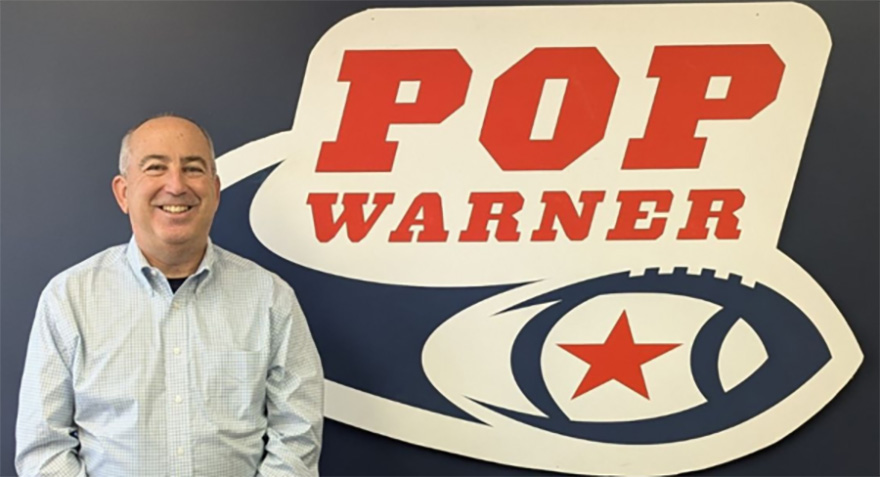
The largest organized youth football program in the world, Pop Warner Little Scholars, is now led by president/CEO Steve Strawbridge, who took the reins in January, 2025. Team Insight caught up with him as the 2026 season approaches to get his insight into the state of the youth football game.
Team Insight: How many children – both for football and cheer are currently registered with Pop Warner Little Scholars? team
Steve Strawbridge: Pop Warner is the gold standard for youth football and cheer and dance. We do not report specific numbers, but we have hundreds of thousands of participants in our programs.
What are the biggest concerns in your new role in charge at Pop Warner Little Scholars?
We have seen significant growth in the past 18 months. We have worked hard to put the systems in place to grow and make sure our scholar-athletes receive the best training and support from our coaches and volunteers along with supporting the kids in the classroom. We need to make sure we continue to have the best volunteers in the country and support them in every way we can, so the kids have the best experience possibly.
Who are some of the great names in football who got their start by playing their youth football at the Pop Warner level?
We have so many players that played Pop Warner that we do not like to name individual players, so we do not leave anyone out. What we say is that at least 75 percent of NFL players started their football careers playing Pop Warner
Are you in a position to introduce a local dealer with the administrative leadership of local Pop Warner Little Scholars chapter?
We absolutely are in a position to introduce and develop any youth football or cheer and dance organization to a Pop Warner League anywhere in the country. We actively promote this.
Football By The Numbers
Football continues as the main revenue category for the vast majority of team dealers around the U.S. According to the Sports & Fitness Industry Association’s (SFIA) most recent Manufacturers Sales by Category Report, in 2025 the U.S. wholesale football market (footballs, protective gear, team uniforms, footwear, and accessories) was $1.492 billion. That’s a 37 percent increase in sales from 2020’s $940.5 million. The wholesale football market in the U.S. has increased every year since 2020. According to the latest participation figures from the SFIA, there are four different categories of football participation – flag, touch, tackle, and 7-on-7. In 2025, there were 8.6 million flag football players, 5.4 million touch, 6.2 million tackle players and 2.8 million 7-on-7.
Of the 6.1 million football players, 2.5 million are considered “core” who are playing 26 days or more a year.
Of the 6.1 million tackle players, 89 percent are male; 57 percent are between the ages of 6 and 17; 34 percent are between the ages of 18 and 34; 30 percent come from households where the annual income is at least $100,000 or more a year; 54 percent are Caucasian/white; 25.5 percent are African American/black; and 22.8 percent live in the south Atlantic region of the U.S.
Two-Minute Drill: Quick notes ON the state of the game ...
John Carroll University athletics department recently hired the first female football coach in the history of its 105-year-old program when Felicia Teeter was named running backs coach. Teeter was previously the head women’s flag football coach at Pratt Community College and Bethel College in Kansas. She also served as the running backs coach to the Bethel College football team. Teeter started coaching football at the youth and high school level in Texas.
The Women’s Football Alliance (WFA), a semi-pro full-contact women’s American football league in the United States, was founded in 2009. It is the largest 11-on-11 football league for women in the world and the longest running active women’s football league in the U.S. It has 40 teams. Besides the WFA, there’s also the Women’s National Football Conference for those females that wish to play tackle football.
Touch, Flag, and 7-on-7. The number of core participants for touch football (those playing 13-plus days/year), flag football (13-plus days/year), and 7-on-7 football (26-plus) is 1.7 million, 2.7 million, and 746,000, respectively.


.svg)