

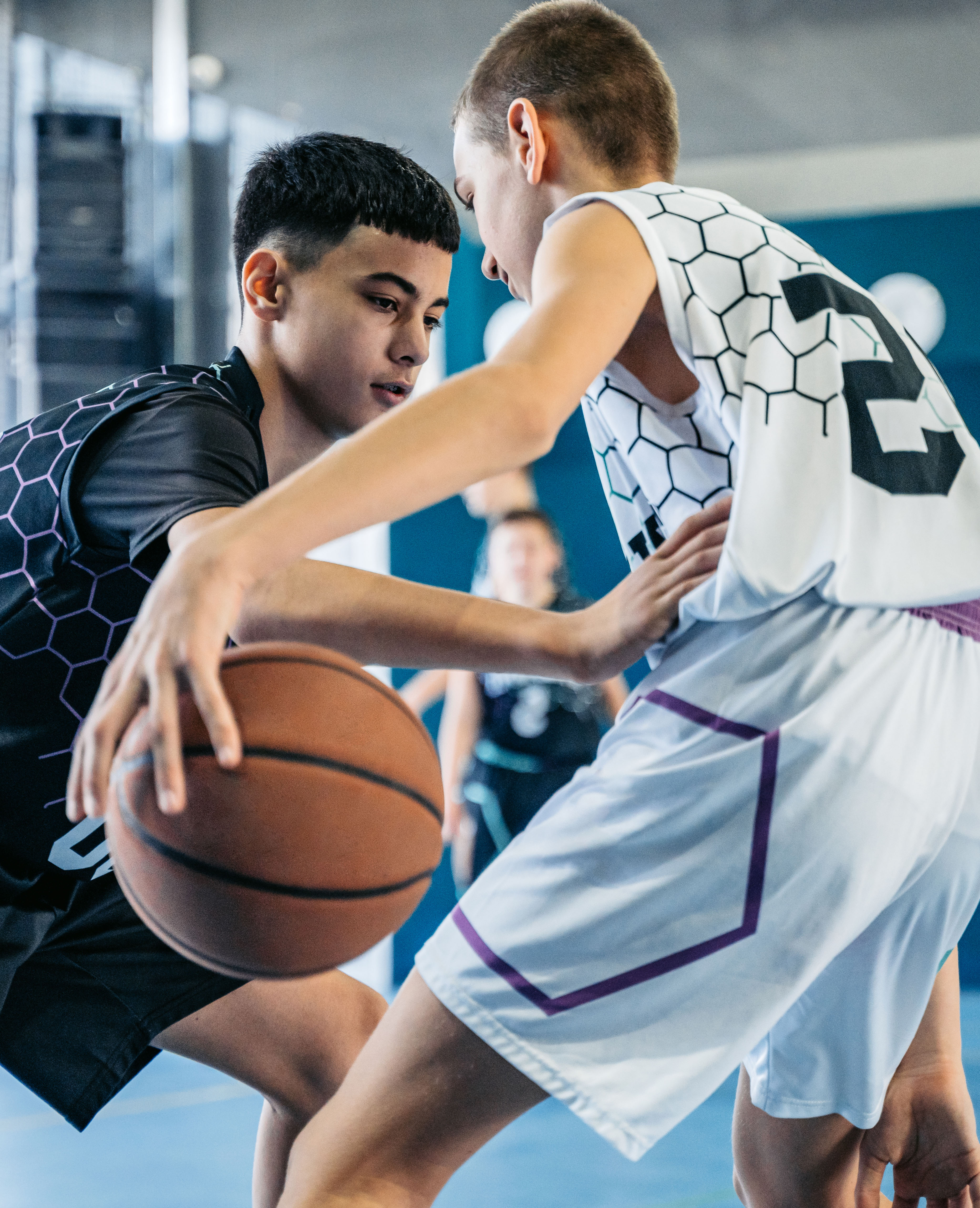
It’s obvious that basketball is more than a passing fancy. The game’s appeal spans all age groups and levels of competition, from youth programs to professional leagues. From 2023 to 2024, total participation in the U.S. increased 7.5 percent, from 29.7 million to 31.9 million, according to the SFIA 2025 Basketball Single Sport Report. At the high school level, hoops ranked third among boys and fourth among girls on NFHS’ list of the Ten Most Popular Athletics Programs as of the 2023-24 school year.
And the good news doesn’t end there. In addition to rising participation, hoops viewership is also strong. The numbers tell the story:
• Women’s basketball, which benefitted from the “Caitlin Clark Effect” in 2024, held unprecedented numbers of fans rapt in front of TV screens and the WNBA reached 1.2 million viewers on ESPN during its regular 24-game season — a record for the once-struggling league.
• On the men’s side, more than 16 million viewers tuned in to Game 7 of the 2025 NBA Finals, the league’s largest audience since 2019.
• The 2025 NCAA men’s basketball tournament also experienced a surge in popularity, with 18.1 million viewers tuning in to watch Florida play Houston on CBS, making it the third most-watched men’s national college basketball game in the last five years, according to Sportspro.com.
A Little Less for Dealers
For most team dealers, basketball continues to be a strong core category, but growth seems slightly muted of late. This likely has less to do with the sport’s popularity and more to do with budgets and possible tariff-related price hikes.
“Basketball is okay, we haven’t seen many changes,” reports Wayne Grantham, president of All-Star Sports in Florence, SC. “We’re seeing an even split between high school junior varsity and travel teams. We’re located right on the border of North Carolina and our state isn’t strong in travel basketball because North Carolina siphons off the more elite players and coaches. We’re seeing decent engagement at the high school level and good involvement on the rec level.”
Grantham also notes that budgets seem to be following industry norms. “The buying is a little more conservative right now — there’s not a stoppage of purchasing, just a greater evaluation of the budget.”
One of the main challenges, says Grantham, is the custom uniform category. Although he sees no big trends in basketball uniforms, he notes that “there’s lots of availability on the Internet with sublimation packages and direct-to-consumer sales. The uniforms may look pretty [on the computer screen] and the prices are alluring, but there’s no telling how the fabric will hold up. The grass isn’t always greener on the other side.”
For this reason, Grantham focuses on building customer relationships.
“Dealer education drives most of the sales experience in providing uniforms and understanding manufacturer timelines,” he explains. “We’re like a concierge team advocate and we can help customers maximize their spend. We present all options that best suit the needs of the customer.
“Being honest and upfront with the customer and not making the dollar the priority is key,” he adds, “Uniforms lead to customer relationships and we use online sales to fill other needs.”
At Hometown Team Sports & Apparel in Green Bay, WI, president and CEO Todd Gutzman notices that “this year is a little slow so far, but it will pick up soon [as we begin servicing] a few new youth groups.” The dealer also serves travel teams – mostly through schools – as well as some AAU teams, and he sees an opportunity to serve more AAU teams in the future.
Regarding budgets: “We’re selling a lot to moms and dads and they tend to spend more than schools that have to adhere to tighter budgets and can’t pay for certain items,” says Gutzman. “Schools have budgets, but parents don’t and will spend on the extras. We do a good business with online team stores.”
Basketball uniforms and equipment are both strong categories for Home Team Sports & Apparel, but footwear isn’t part of the mix due to the unwanted complexity and cost of having to stock a huge range of styles and sizes.
In the uniform category, sublimation is key. “Everybody is going for sublimated because there are better graphics options,” says Gutzman. “There are lots of great companies to work with in sublimation.”
Fortunately, reports Gutzman, “Most places we buy from are U.S.-based so tariffs aren’t an issue. Our challenge is getting the word out to youth groups that we offer great products and service. As kids grow up, new moms and dads take over and we’re trying to keep that business in-house.”
In the Pacific Northwest, Bashor’s Team Athletics in Portland, OR, has a stable basketball business.
“We sell a lot of balls to schools but not much apparel since we’re in Nike’s backyard,” says president Julia Sherman. “We service a lot of youth leagues and schools. Although basketball isn’t a strong category for us, our biggest opportunity is youth groups, for sure.”
Sherman reports that budgets aren’t a problem so far, “but we might see issues [after July 1] when new budgets are issued.” She adds, “For us, the biggest challenge is that we don’t sell Nike apparel. But we have no issues selling basketball hardgoods.”
FAST BREAKS
• From 2023 to 2024, total participation in the U.S. rose 7.5 percent, from 29.7 million to 31.9 million, according to the SFIA 2025 Basketball Single Sport Report.
• Of the 31.9 million Americans ages six-and-up who played basketball at least once in 2024, 23 million were male and 8.9 million were female.
• High school girls’ basketball had 367,284 participants and 18,090 schools, making it the fourth most popular girls’ sport on the NFHS’ ranking of the Ten Most Popular Girls’ Programs for the 2023-24 season.
• High School boys’ basketball had 536,668 participants and 18,587 schools, making it the third most popular boys’ sport on the NFHS ranking of the Ten Most Popular Boys’ Programs for the 2023-24 season.


.svg)