
As the textile industry searches for new feedstock sources, textile-to-textile recycling is gaining serious momentum. Waste is increasingly viewed not as a problem, but as a valuable raw material stream. While mechanical and chemical recycling are now established across the industry, a third pathway is emerging: enzyme-based recycling.
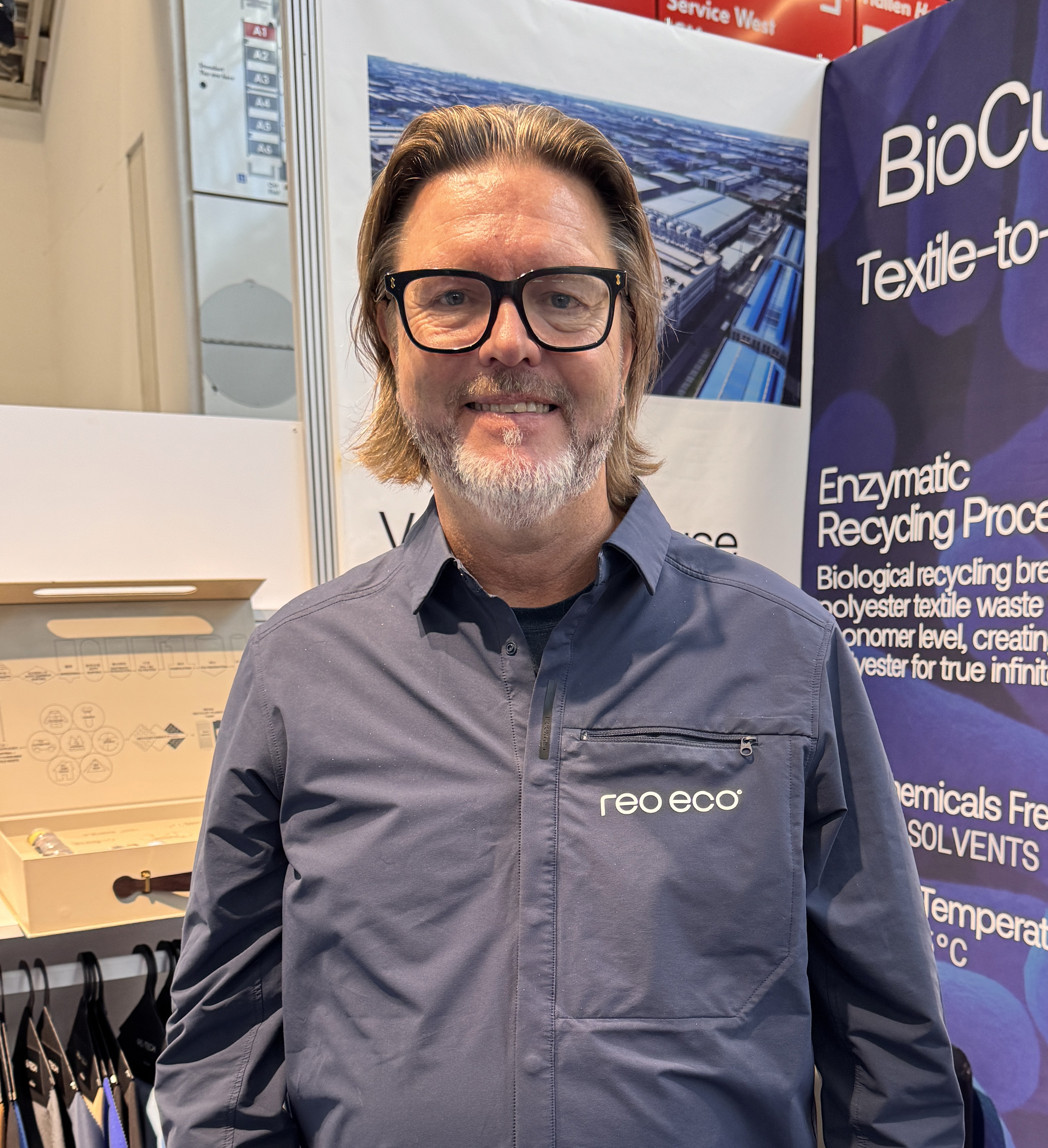
REO-ECO is advancing this biological approach with its BioCulus process, which converts polyester textile waste into high-quality filament yarn. At the heart of the technology is a specially developed enzyme that breaks down polyester into its original building blocks. The process targets PTA (Purified Terephthalic Acid) and MEG (Monoethylene Glycol) — the petroleum-derived monomers traditionally used to produce polyester (PET). By separating polyester waste back into its monomers, the process delivers material purity comparable to that of virgin polyester.
Initial trials required around 17 hours to break down the polyester. Continued development reduced this to 12 hours, then 10, while simultaneously improving purity. The result was what the team describes as a real “wow moment”— highly purified PTA and MEG separated down to monomer level, enabling polyester to be recreated without any loss of quality.
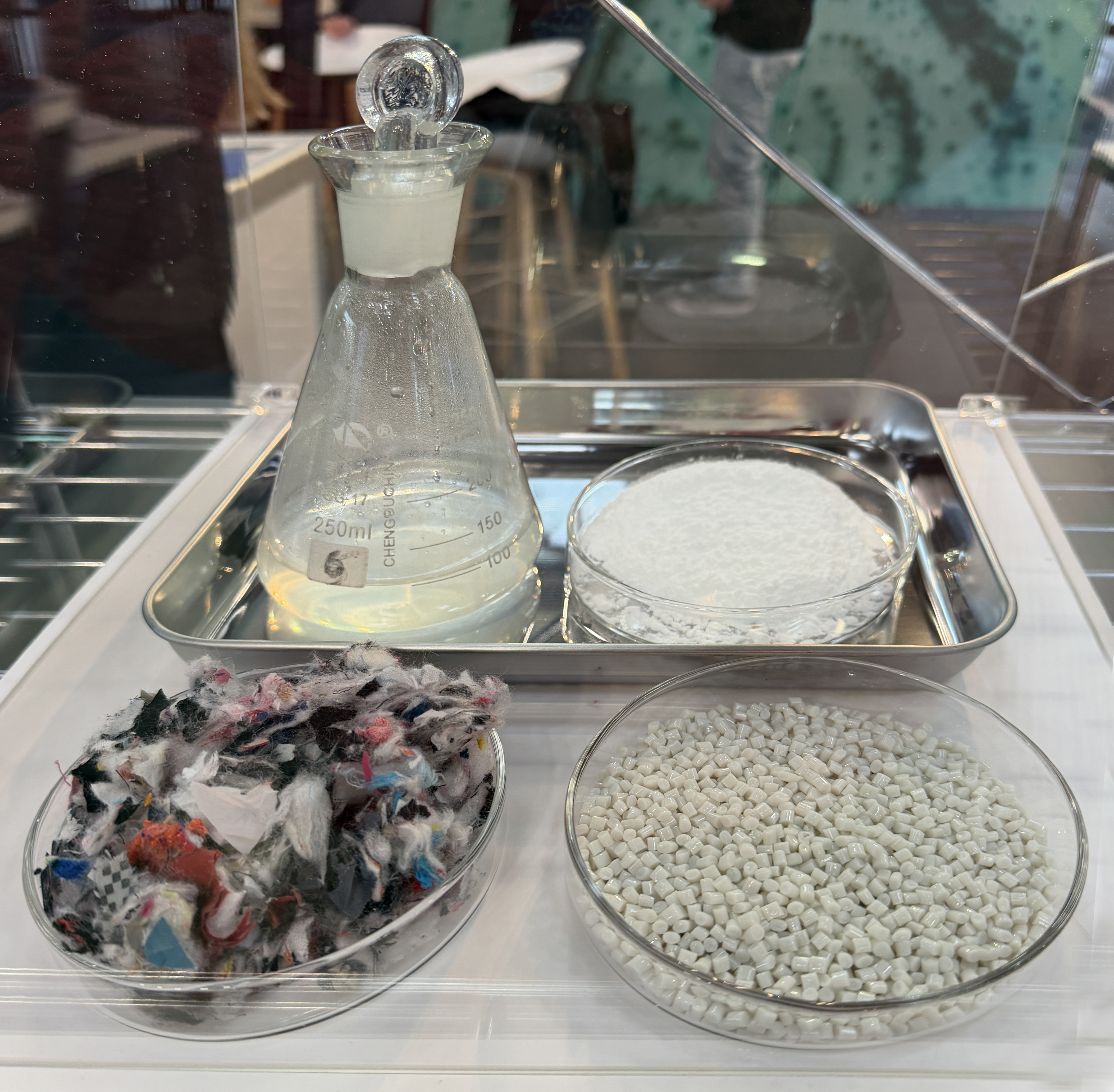
China-based REO-ECO controls the entire process, from enzyme development through to recycling. Operating at just 60°C — slightly above room temperature — the system requires minimal energy and no additional chemicals. The enzyme simply breaks the polyester polymer chains, separating MEG from PTA. The resulting white PTA “cake” is then ground into powder and re-polymerized into recycled polyester chips, ready to re-enter textile production.
Stefan Edkvist, a pioneer in dope-dyeing technologies and closely involved in REO-ECO’s enzymatic development, emphasizes that collaboration will be critical for scaling solutions. “I’m not saying this is the only solution,” the director of business development explains. “If you do that, you only create enemies. I want friends who recycle and work together. The reality is we must reduce our use of virgin polyester. Production is moving from 70 million tonnes to 100 million tonnes. Without cooperation across the industry, we simply cannot catch up.”
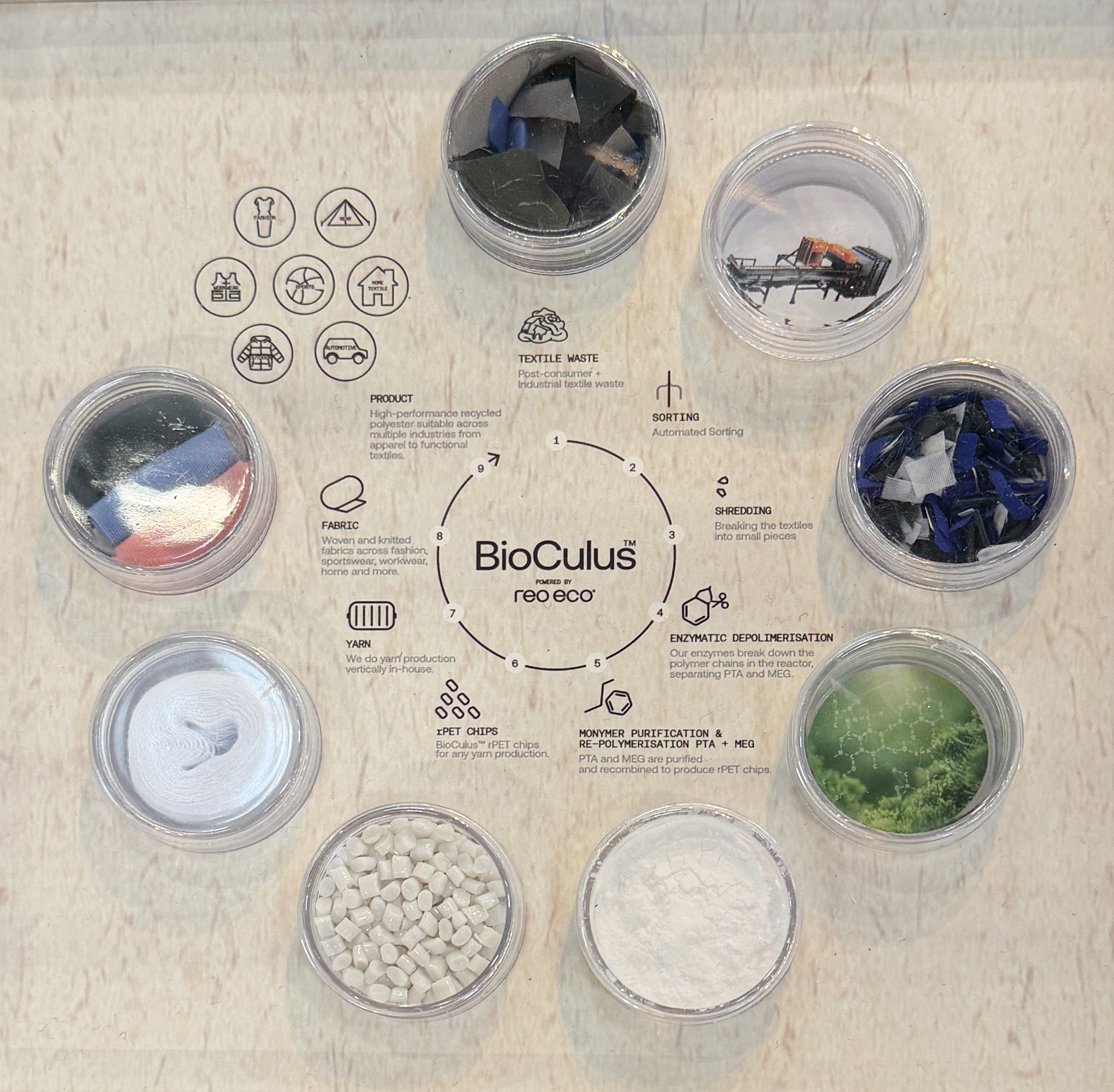
Unlike mechanical recycling, which often introduces impurities and degrades fiber quality, enzymatic recycling breaks down polyester into its fundamental monomers, enabling true textile-to-textile circularity. Another advantage lies in feedstock flexibility. The enzyme specifically targets polyester, meaning mixed materials can still be processed.
“We focus on the polyester content,” Edkvist explains. “Ideally it’s 100% polyester, but it doesn’t have to be. Even blends with spandex or other fibers can be processed. Our enzyme breaks down only the polyester — everything else can be filtered out. Color doesn’t matter either. Whatever goes in, we always produce pure white PTA.”
The filtered dye residues can be returned to dye manufacturers, while separated materials, such as spandex, can be redirected to their own recycling streams. The result is a closed-loop approach that minimizes waste even from blended textiles.


.svg)